Keep this page open while reading a proposal. If an estimate uses a term not listed here, ask the contractor to explain it in writing. A clear scope uses words that both sides understand, and any reputable contractor should be willing to define them.
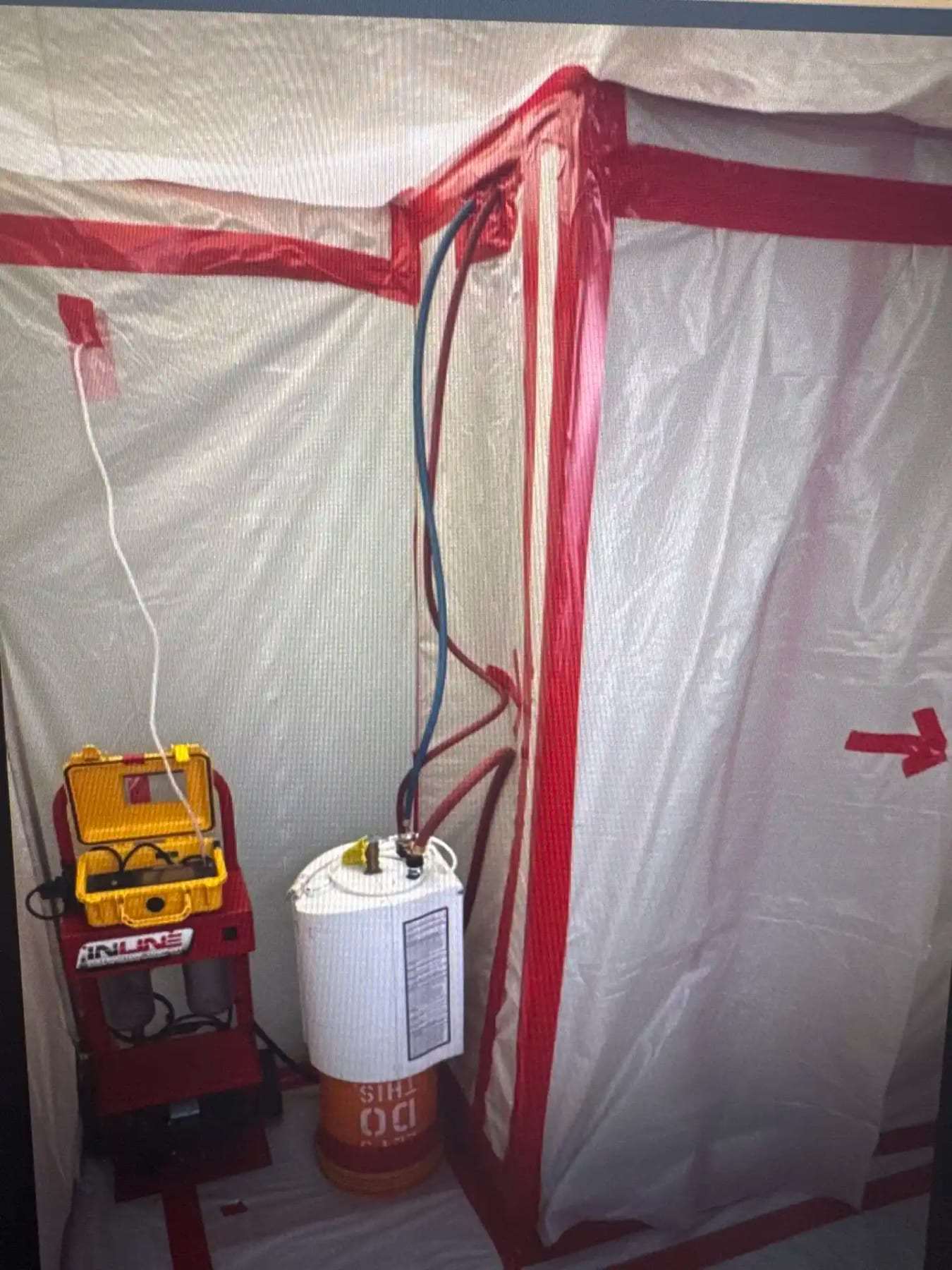
Zippered plastic containment with a decontamination unit and supplies outside it. Included to show the kind of work involved, not a property or job connected to this site.
Setup and protection
- Containment
- Plastic sheeting that encloses the work area so dust and spores stay inside it.
- Negative air
- Running a HEPA air machine that exhausts air out of the containment so leaks flow inward.
- Air scrubber or air filtration device
- A portable machine with a HEPA filter used to clean air or create negative pressure.
- PPE
- Personal protective equipment: respirators, disposable suits, gloves and eye protection.
- Critical barrier
- Sheeting that seals an opening such as a vent, doorway or register so air cannot pass.
Removal and cleaning
- Source removal
- Physically taking out contaminated material rather than treating it in place.
- HEPA vacuuming
- Vacuuming with a high-efficiency filter that captures very small particles.
- Damp wiping
- Wiping surfaces with a damp cloth, often with detergent, to pick up settled dust.
- Media blasting
- Cleaning wood with soda, dry ice or other abrasive media, mainly in crawlspaces and attics.
- Encapsulant
- A coating applied to cleaned wood. It is not a substitute for removal.
- Antimicrobial
- A product meant to suppress microbial growth. Its role is secondary to cleaning and drying.
Standards, conditions and completion
- IICRC S520
- An industry standard for professional mold remediation, published by the Institute of Inspection, Cleaning and Restoration Certification.
- Condition 1, 2, 3
- Terms from S520 describing normal, settled-spore and actual-growth conditions in an area.
- Moisture mapping
- Measuring and recording moisture across materials to find wet zones.
- Dry standard
- The moisture reading that materials must reach, often compared to unaffected material in the same house.
- Post-remediation verification
- A check after work, visual and sometimes with sampling, to confirm the area is clean and dry.
Common questions
- Do I need to understand every term to hire someone?
- No, but knowing the core ones, especially containment, negative air, source removal and verification, makes it much easier to see whether a proposal covers the essentials. Ask about anything that is unclear before work begins.
- Does the law require following the S520 standard?
- No. It is an industry standard that many professionals use as a reference. Colorado does not license mold remediation, so standards like this are a voluntary benchmark. Ask whether a contractor follows it and how.
General information for Wheat Ridge, not a quote or professional advice. In an emergency, call 911.